What is work to you?
When does the line cross between exercising a life-long calling and dragging your body through a 9-6 routine?
As the hours become days, the days become weeks, the weeks become months, and one can't help but wonder what will come at the end of the tunnel. What does one see beyond the paper shuffling, carrying out of orders from above, and enduring the punishing over-time schedule?
Mark Twain once joked that Man is a creature made at the end of the week's work when God was tired. God subjected Adam and Man to painful toil all the days of their lives as punishment for their intransigence. Man was not just a result of His work - we are made to work.
But work we must. No one said it was going to be easy. Nor will anyone hand you candy, hold your hands and sooth your ego with fine sugarcoating. Work can be intense and no one is going to apologise for that.
Above all, work is like living a faith. You have to find a reason to believe and hold on to it firmly. Beliefs may change, and life is a journey of finding the right set of beliefs that fit with our values, aspirations and dreams.
As an officer in the foreign service, I sometimes find myself fighting futile battles against the Great Wall of bureaucracy, and the armies of people looking to "cover" (protect) themselves on the job, sometimes at the expense of efficiency. Bureaucracies are a fixture in huge organisations, including the civil service, which is a necessary irritant to work with.
But these naggings aside, working on international relations is a whole new ball game beyond the theoretical models we used to explore as students, and the polished and simplified articles we read in the press. It is like being at a soccer match and watching the game from the start to finish. The audience gets to note every single foul committed by the players, the dirty tricks that players sometimes employ to get ahead, but also the little triumphs that makes soccer the phenomenal sport that it is. This definitely beats reading about the results from a news headline.
You get privy to the thoughts of the world's movers and shakers: Presidents, Ministers, politicians, diplomats, academics, and more. You become aware of the dynamics of competing and converging national interests, and the ruthlessness of realpolitik. You also become involved in the cumbersome but important process of drafting texts where the slightest misplacing of a comma can mean everything.
International relations used to be a distant blur of wars fought between diplomats and soldiers, and spoken in a language that may as well be Klingon to any of us. But now, I am more appreciative of how it affects the world, our national interests and our daily lives. Diplomacy is a world that never tires or sleeps. For every minute that we rest on our laurels, our foreign compatriots are probably working as hard, or even harder, to get ahead.
Take for instance the Doha Round negotiations in Geneva: The trade representatives to the World Trade Organisation engage in horse-trading and deal-making to protect their national interests. Sometimes, they have to work behind-the-scenes to gather allies and deter rivals. We work hard so that the food we put on the table will remain affordable, our companies can enter new markets without fear of their technology being stolen by competitors, and there are enough jobs to go around, among many knock-over effects of effective diplomacy.
The movies may glamourise diplomats as sipping champagne while rubbing shoulders with the world's elite and striking deals that will affect the world. WikiLeaks may remove the veil of secrecy over diplomacy and reveal the hilarious side of political reporting. Cast those impressions aside, diplomacy is about ensuring the continuity of our way of life and making our society a little better for you and me to live in, by ensuring that our interests are secure.
I guess I will be staying at where I am for some time: watching, learning, experimenting, making mistakes, but above all, holding on to a faith.
Showing posts with label Memories. Show all posts
Showing posts with label Memories. Show all posts
Tuesday, November 30, 2010

Monday, June 28, 2010
Seek ye faith goals
I spent some time in the summer thinking about the next phase of my life. Work for me may start in exactly a week's time but life doesn't end here. Rather, it opens up a phase of financial freedom and greater personal responsibility that are best channeled to achieving specific 'faith goals'.
Setting faith goals is different from setting SMART goals. What are 'faith goals'?
"A faith goal is a goal set in hope and based on things unseen. It is setting a goal that is measurable and based on spiritual power. That is, the power to create and imagine what is not yet seen or made manifest." (Source)
For example, someone who sets a goal of becoming the most successful trainer in Singapore may not necessarily know how to achieve it or begin immediately. He (or she) does it out of faith, and the belief that God will show a path to achieving this goal.
As I continue to put some thought into my faith goals, here are some (admittedly ambitious) goals I've set for the next few years.
Traveling:
- Travel (preferably backpack) to 3 different countries a year. I will journal my travels based on themes specific to the countries. Who knows, I might even get to write a book on it! Thanks to Varun for this idea
- Join an open cell with the adult service. I've spoken to Pastor about this and I'm quite keen to hear his plans
- Serve with the church's PR wing, considering the rapidly-changing landscape that mega-churches find themselves operating in today. Credit to Josh and Jason for giving me this inspiration
- Resume my first love: fencing - probably with my previous club, Z Fencing. Hope to see some familiar faces. Weekday nights will never be the same again.
- Get a beginner's diving license so I can finally experience the awesome diving sites in Southeast Asia
- Achieve silver for IPPT every year
- Run 2 half-marathons and a full-marathon per annum
- Take up golf. I've decided to do this when I learnt how cheap it was to take up a course and hit 100 balls at the range per game
- Savings rate of 50-70% to be partially invested in time deposits, REITS and unit trusts (with medium-low to medium risk for a 10-yr horizon period at 10 to 15 percent growth per annum). I'm beginning to outgrow my Prudential and Great Eastern savings plans
- Clear my Class 2 and 3 license. Since my travels to India and Vietnam, I've decided that the best (and fun) way to survive in many developing countries is to negotiate the maze of traffic by motorbike
- Finish a book every month
- Get a diploma in a third language (either Arabic or a SEAsian language)
- Purchase a DSLR and start snapping!
Saturday, June 12, 2010
Goodbye to freelance writing
It's official. My freelance writing career has come to an end.
No more contributions or short columns in the Straits Times: Youthink. No more set piece articles for the Business Times Campus Life.
The Government simply can't let one of its civil servants run amok and write to (or for) the media. And as an employee, I can't moonlight with a second career.
Writing has, in a way, been a form of rebellion for me. It has been about speaking up, challenging the status quo at times, or advocating a certain point of view, even if it is not the most popular. Disagreements can happen but in the best of scenarios, we all agree to disagree. The freedom to write is addictive but it comes with a price: exposed to public scrutiny, you have to stand by everything that you write, or risk your credibility.
But after more than four years, seeing fellow writers and editors come and go, and with more 40 pieces to my name, I still believe that I have so much room for improvement. Writing, while soothing and therapeutic, can also expose your shortcomings and vulnerabilities, fears and regrets, because writing demands a certain level of critical self-evaluation and frankness that many will shy from.
But it's not entirely over. Writers, as people, can evolve too.
This summer, I have a new vision: to visit at least three different countries a year, preferably on a backpacking trip, and write about these trips. There is aplenty to write about their history and culture, the wonderful people that you meet, the crazy things that you do, and the insights that you get.
I especially enjoy the flood of ideas and excitement whenever a new experience emerges, time slows down when all of my senses are activated, and I tell myself," Man, I'm so gonna write about this."
Alas, a lot of these "real, in-your-face" experiences will never be possible on a guided working trip which includes living in hotels and taken to sight-seeing places in an air conditioned bus. To fully experience life in another country, one has to trudge it out on foot, brave the traffic conditions, eat street food, and mingle with the man on the street. But as one grows older, that becomes less possible.
But till then, the dictum remains the same: the pen is certainly mightier than the sword, while words can be sharper than the finest blade, and louder than the biggest guns in the world.
Sunday, April 25, 2010
Finishing the marathon after 4 loonngggggg years
"There is a time for everything, and a season for every activity under heaven", - Ecclesiastes 3:1
It's that time of the year when the Government releases its revised forecast for the year's economic growth, more babies are born (yes, many more April and May babies out there), the stream of campus crowd whirls down to a trickle, it's harder to get flight tickets for that summer holiday, and yes, people graduate.
I never thought I will ever write this post four years ago. Fresh out of summer orientation camp, there was me, part of an army of blur, beady-eyed freshmen sighing about the prospects of intense class participation in our first day of class in 2006, and looking lost amidst the sea of equally-lost freshmen. Back then, graduation seemed like an eternity away.
Now, convocation seemed like yesterday.
4 years of group projects, term papers, presentations and examinations has now given way to: many, many more years of group projects, term papers, presentations and examinations, especially for folks like me joining the Civil Service.
Graduation is more akin to finishing a marathon than getting the top poles in a race. In a 21 or 42-km marathon, no one gives a damn about the winner, or remembers his\her name 1 year down the road. But everyone remembers the sweat, the breathlessness, the little triumphs we get when we edge a little closer towards the finish line, the sight of hundreds of runners running alongside you on the same journey, and sometimes the pain when your ankles give way.
Here are some 10 take-aways that I want to impart to you, my dear reader. If you have already graduated, kudos to you and I hope you relive a glimpse of your student life amidst these words. If you haven't graduated, I hope you will find some strength or inspiration from here.
1. Making $1 million & cooking Naples-style spaghetti
Not satisfied with what you're learning in class? Get out and choose from the countless seminars, workshops and conferences in school or beyond that caters to almost every whim and fancy. Every semester, there are entrepreneurs, academics, activists, journalists, bureaucrats and others speaking on topics ranging from making $1 million before the age of 28 to cooking Naples-style spaghetti. Be inspired, and inspire others.
2. The limits of a 5-year old online portal
Don't complain about the school not providing enough internship opportunities for you. I've come to realise how students have become so reliant on OnTrac. The last thing that you want to limit your future with is a 5-year old online portal manned by 4 blokes. There are literally hundreds of companies and organisations that you can apply directly with that is sure to be aligned with your interests. Take some initiative and do your own research. Write in YOURSELF.
3. A smile a day may bring a favour your way
Be nice to all the staff, even the security guards and cleaners. Put yourself in their shoes. They have a job to do, so don't get in their way by making unreasonable demands, or not cooperating with them. Be nasty to them and you make their job even worse. Be nice to them and you bring a cheer to their day, even a favour that will be paid back when you need their help again (and you will, trust me).
4. Some of the best friends I made...
Are the ones I met through joining student clubs. Yes, one of the best ways to make friends is to join a student club. Sink your roots in and commit to a few good years. You will be surprised with what you learn, the number of people you meet along the way, and even meet your future beau. Don't join a club just for your resume. People can tell if you're genuine or if you're there for selfish reasons.
5. For taking that solo stroll
If you ever need a quiet place to read (not the library), chill or just walk to get inspiration, try the Singapore Art Museum with its cafes and galleries, the Esplanade and its windy roof-top, the National Museum with its lovely Novus bar, the Fort Canning Park with its mini-maze of flora and fauna, or even our very own Wellness Centre with its massage chairs and dim lights. Plus there are about a hundred more places that you can go to (Buzz me if you need more information).
6. The world is a book & those who do not travel read only a page
To get something akin to changing your perspective of life, go overseas for an exchange, internship, or even a prolonged CIP. Regardless of where you go to, the key is get yourself away from the hustle and bustle of Singapore, immerse yourself in a foreign culture (no, playing beer pong with the Irish does NOT count), witness how their people live and work, and put yourself in their shoes. Limit yourself to Singapore and your mindset will always be limited at that.
7. Of bad emails & worse excuses
I'm always bemused by how many students clubs can be so unprofessional, given the string of horror incidents such as emails being addressed to the wrong CEOs (sometimes they get the gender wrong too), with multiple typos, and a whole lot of other stuff that can get you fired in the corporate world. There is no excuse for not getting your facts right when it's within your locus of control. Always think about how others will perceive your club's name. Treat others professionally and you will be given the due respect too.
8. It's not just about watching the time, dear
Effective time management is not just about cramming as many tasks and responsibilities into your 24 hours a day. It's also about keeping to your word, committing to your goals, and doing what you say you will do. If you find yourself apologising once too often for late work (or late replies..."Eh guys, sorry for the late reply \ sorry for sending this in late") and broken promises, perhaps it's time to stop apologising and do a revamp of your time management plan.
9. Quit the verbal diarrhea
Let's face it: we all like to complain about our long days, workload, lousy food, and other issues unfortunate to be the target of our verbal diarrhea. We take a certain pleasure to hitting back at "the system" (because it's so darn cool to be a rebel) and making ourselves the anti-hero or the victim in the story. But let's ask ourselves: when are we ever going to be satisfied with our lives? Being a responsible student is more than just putting in the hours in the library. It's about being a part of the school community, giving feedback to people who are in the position to make changes, or getting your peers together to make some REAL change. Don't just sit on your asses all day and complain (I call that "potshot sniping").
10. YOU can be the source of change
I've always found it more exciting to talk to people who are passionate about a cause: whether it's about improving student welfare, helping the less fortunate, or even pushing to set up a mahjong club despite repeated rejections from the administration. As Bill Gates said it at a Harvard Commencement, one of the greatest experiences one can ever have in life is to be an activist of sorts to take on the big inequities in our community and the world. Rather than just being mere robots without a soul or conviction about an issue, why not make a stand and see how you can be that source of change?
Saturday, February 13, 2010
The truth has been set free
My Mum is truly the epitome of strength and resilience.
For four years, she harboured the truth behind her wanting to separate from my Dad.
As a result, she could not sleep properly, even when she moved out of the family home. Not always a good communicator, she did not share her burden with us but chose to let her actions do the talking: working hard running her own business and silently caring for her children by protecting the family assets for our future.
All the while, the truth cried to be set free but as a woman, she chose to suppress it for the good of the family.
This week, the truth finally surfaced. It came as a shock but we realised how crucial it was to move on. To simply linger in the past and point the blame finger is destructive and pointless. As a family, we have had enough of the quarrels and umpteen family meetings to mediate in disputes between both of them. We had to move to a space where new possibilities can be created.
As the saying goes, to win in life, sometimes one has to lose some. None of us asked for this to happen, but you can't have everything in life. You have to adapt and make the best of the situation.
My parents have decided to officially go their separate ways with no more claims against each other. It is for the better. Now, my Mum is happier and there seems to be this great and invisible burden lifted off everyone's chest.
Now it's time to rebuild the family again with faith, hope and love.
Thursday, December 31, 2009
We will remember you Rajan...
It came without warning. So sudden and so painful to register.
I still remember the shock when I received the SMS. It was meant to be a day of elation and good wishes but the SMS brought me back to reality. I initially thought that it was a joke - it has to be - but no one jokes about such things.
With my fingers still trembling on the phone keypad, I passed on the SMS to friends, some of whom are still overseas in the midst of their festive revelry, without a clue of the news to come.
I hated to be the bearer of bad news. I knew some of the many friends Rajan had. He was a popular guy who had friends from Singapore, Malaysia and all around the world. He was a regular face at international and exchange student gatherings. People warmed up to him easily because of his easy nature, ever-ready smile and a heart that had nothing but warmth and humour for those who explored deeper. Among groups of friends, Rajan always had a story to share, a grievance to air, a joke to crack, and an encouragement to make.
And all of a sudden, all of these friends had one less reason to smile about for the new year. Whoever we are, wherever we are, we all felt the loss: the void in our hearts simply cannot be replaced by the jovial end-year celebrations.
I really miss the conversations I had with Rajan. He was the kind of guy that you could bump into at the entrance of the library and strike a conversation that could last for an hour or so. If you needed a meal buddy, Rajan was always in the library to approach.
I remember the meals we had where we talked about anything related to life, philosophy, religion, politics, economics and society. Rajan, being a big critique of Singapore, SMU and our way of life, would go on and on about how we should never settle for less, while I would always defend the status quo and jokingly point out that our Malaysian neighbours never had it better. He would then roll his eyes before partaking a final shot of his trademark sarcasm and diatribe that always never fails to make me laugh.
Despite his controversial views, Rajan always had a heart for the community and society. Apart from being a top debater, he was involved in Campus Crusade for Christ (where we met in 2006) and as a residential senior at the SMU hostel. He was always there to integrate new students into the community, offer advice to home-sick international students, or to share a beer or two with you because you had a bad day.
But what made Rajan stand out from the crowd was what he stood for. He was a staunch Christian, a rebel, a fighter, an idealist and an intellect, always true to himself and his beliefs, and never shirking from an opportunity to debate on many issues. With a formidable understanding of poverty and women's rights, he always voiced out against social inequalities and injustices. He would make a fine example of how civil society and non-profits should be.
Rajan truly taught me how to live life with no regrets, to be true to myself, stand up for my beliefs and never shirk from any challenge that comes my way. In his passing, I will always fondly recall the good times that we had and the memories that we shared.
In this time of adversity, together with all his friends who feel the loss, my heart and prayers goes out to Rajan's family.
 With members of the SMU chapter of Campus Crusade for Christ at Metamorphosis Camp in December 2007
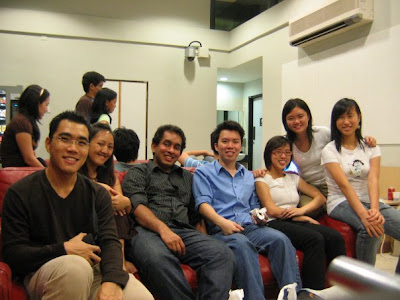 At a gathering with friends at the SMU hostel in early 2008. I still remembered how impromptu this gathering was, having received news about it a few hours before it happened
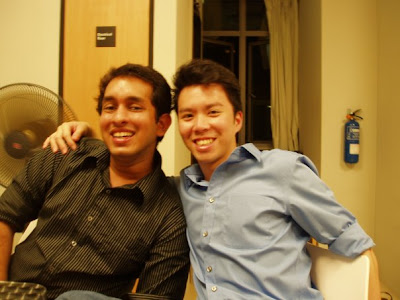 Taken at his apartment at the hostel. That's Rajan with his ever-ready trademark smile that shone of warmth and friendliness. I will really miss it
I still remember the shock when I received the SMS. It was meant to be a day of elation and good wishes but the SMS brought me back to reality. I initially thought that it was a joke - it has to be - but no one jokes about such things.
With my fingers still trembling on the phone keypad, I passed on the SMS to friends, some of whom are still overseas in the midst of their festive revelry, without a clue of the news to come.
I hated to be the bearer of bad news. I knew some of the many friends Rajan had. He was a popular guy who had friends from Singapore, Malaysia and all around the world. He was a regular face at international and exchange student gatherings. People warmed up to him easily because of his easy nature, ever-ready smile and a heart that had nothing but warmth and humour for those who explored deeper. Among groups of friends, Rajan always had a story to share, a grievance to air, a joke to crack, and an encouragement to make.
And all of a sudden, all of these friends had one less reason to smile about for the new year. Whoever we are, wherever we are, we all felt the loss: the void in our hearts simply cannot be replaced by the jovial end-year celebrations.
I really miss the conversations I had with Rajan. He was the kind of guy that you could bump into at the entrance of the library and strike a conversation that could last for an hour or so. If you needed a meal buddy, Rajan was always in the library to approach.
I remember the meals we had where we talked about anything related to life, philosophy, religion, politics, economics and society. Rajan, being a big critique of Singapore, SMU and our way of life, would go on and on about how we should never settle for less, while I would always defend the status quo and jokingly point out that our Malaysian neighbours never had it better. He would then roll his eyes before partaking a final shot of his trademark sarcasm and diatribe that always never fails to make me laugh.
Despite his controversial views, Rajan always had a heart for the community and society. Apart from being a top debater, he was involved in Campus Crusade for Christ (where we met in 2006) and as a residential senior at the SMU hostel. He was always there to integrate new students into the community, offer advice to home-sick international students, or to share a beer or two with you because you had a bad day.
But what made Rajan stand out from the crowd was what he stood for. He was a staunch Christian, a rebel, a fighter, an idealist and an intellect, always true to himself and his beliefs, and never shirking from an opportunity to debate on many issues. With a formidable understanding of poverty and women's rights, he always voiced out against social inequalities and injustices. He would make a fine example of how civil society and non-profits should be.
Rajan truly taught me how to live life with no regrets, to be true to myself, stand up for my beliefs and never shirk from any challenge that comes my way. In his passing, I will always fondly recall the good times that we had and the memories that we shared.
In this time of adversity, together with all his friends who feel the loss, my heart and prayers goes out to Rajan's family.
 With members of the SMU chapter of Campus Crusade for Christ at Metamorphosis Camp in December 2007
 At a gathering with friends at the SMU hostel in early 2008. I still remembered how impromptu this gathering was, having received news about it a few hours before it happened
 Taken at his apartment at the hostel. That's Rajan with his ever-ready trademark smile that shone of warmth and friendliness. I will really miss it
Wednesday, December 30, 2009
My biggest birthday present this year...
Has to be my dear sister Colleen getting married to a wonderful husband!
 My Dad proudly walking down the aisle of the hall of the Church of St Ignatius with his daughter's hand in tow. It must be a very proud (and poignant) moment for him to be presenting his daughter to the bridegroom, Andrew.
On a separate note, I really enjoyed the ceremony, the choral music and the solemnness of the event. It's a throwback to my upbringing in Catholic schools from young.
 That's Andrew and Colleen after the change of attire for the dinner at the Four Seasons Hotel ballroom. It was also a great time to catch up with relatives and old family friends, albeit with many new faces from the bridegroom's friends
 The traditional pouring of champagne by the couple before the toasting of the couple by the immediate family and the bridal brothers and sisters. That must surely be one of the highlights of the evening
This marriage, being our first marriage within our direct family, is a milestone in my family history. My sincerest prayer to the newly-weds that God will bless this marriage to be blissful and ever-lasting, that you will both provide a pillar of strength and support to each other in times of joy and need, and always serve God and His community with passion and grace.
I also saw how this marriage is starting to bring our family closer together, tearing down walls brick by brick. It is indeed mentioned in 1 Corinthians 13 that "Love is patient, love is kind. It does not envy, it does not boast, it is not proud. It is not rude, it is not self-seeking, it is not easily angered, it keeps no record of wrongs... It always protects, always trusts, always hopes, always perseveres." May we persevere on as a family that trusts, protects, hopes and loves one another.
And our next stop: the second wedding celebration at the bridegroom's side at Kuala Lumpur over this weekend!
Wednesday, December 23, 2009
Reflections about the Gulf
We have a slew of articles providing coverage on the BSM programme and our findings from our trip that will be published in the press in the next couple of weeks. It's about time I close the chapter on this. I will collate and provide the links to them soon. Happy reading!
Meanwhile, to summarise my experience during the trip, it was an eye-opening experience and indeed one of the top highlights of my SMU experience.
The Gulf have and always will remain an enigma to me. It is a region which is blessed with so much resources but for many decades, their societies and economies remained stagnant and closed to the world, their people housed in a cocoon of comfort with lavish state welfare, until new leadership realised that resource wealth will not last forever and it was critical to evolve to avoid redundancy as the world powers ahead.
Using the billions from their oil wealth, they embarked on a massive modernisation campaign, drawing up massive master plans, importing the best talent that they can find, and the best materials and equipment that the world has to offer. Dotted by futuristic-looking buildings, cranes and construction sites, cities like Doha, Dubai and Abu Dhabi even resemble high-growth cities like Shanghai and Mumbai. A local that I spoke to in Doha lamented that there are so many new changes that makes the city look so different as it perpetually remakes itself every year.
The region is awash with so much cash that companies from all around the world have flocked to fight for a piece of the pie. Just yesterday, the UAE awarded a US$25 billion contract to a South Korean consortium to build nuclear reactors.
However, one can never continue to buy modernity forever: one has to create them from within, capitalising on the energies and talent of its people and enterprises, and living up to their historical roots as traders. Human capital management is an area where the Gulf still lags sorely behind the world. And while some selected state-owned enterprises like Etihad and Aramco have became a brand of success, there is still much progress to be made by their small and medium homegrown enterprises.
But what really fascinates me is that beneath the glitz and glamour of modernity in the Gulf, it is still a region where politics and religion play an often combustible role in economics and society, where overt displays of Arab solidarity masks deep divisions and intense rivalry, where form often is more important than substance, and the Arab business culture emphasis on relational subtleties and well-heeled connections to clinch business deals.
The Gulf will always be a paradigm of contradictions and intrigue, but also an exciting emerging market for businesses to expand into and cut their teeth.
It is this excitement that makes me really want to go back again and stay for a longer period of time to study the region and culture. Perhaps I might apply for one of the internships netted by this BSM, and do a short stint at the independent Gulf Research Centre after I graduate before working full-time in Singapore. There is simply so much to do and learn about the Gulf.
Here are some shots from the trip:
 The Saudis are legendary for their hospitality. Here, the class settles down to a meal hosted by Mr Faisal Al-Dhfeeri, Director for Public Relations of the Royal Commission for Jubail and Yanbu. Notice our girls wearing the abayas and sitting at a separate table from the guys
 Next stop after Saudi Arabia: Bahrain! The world famous Bahrain Financial Harbour - still in the middle development phase - houses many international and regional banks. The Kingdom continues with its plans to diversify with the Bahrain 2030 Economic blueprint. One aspect naturally involves building on its status as a regional logistics and finance hub
 Over at Doha, Qatar, Lusail City stands out as a bold mega-project to build residential, commercial, entertainment and cultural developments. With enough natural gas to last for the next 100 years, Qatar has enough finances to back its weight in gold
 A further extension of the Lusail City project. The sea bridges link the City to the rest of Doha. Do however note the potential impact of such developments to the environment, especially the sea
 The class prepares for a briefing at the Qatar Financial Centre. During our trip, we had the opportunity to talk to representatives of the business community, academics, policy-makers and diplomats to have a well-rounded feel of developments in the Gulf
 The Atlantis at Palm Jumeria, an upscale district of hotels and residential apartments in Dubai. Check out the price tag of spending a night at its famous Poseidon Suite which boasts three well-furnished floors, a lift if you ever feel lazy to take the stairs, and an unfettered view of an aquarium that houses 65 000 fish: US$10 000
 The Ski Dubai is an in-house ski park at Emirates Mall. If winter doesn't come to the Gulf, the Arabs were sure to at least import some winter, and construct it right at their very door step!
 The amazing Burj Dubai - the tallest building in the world which houses offices and residences. The Burj Dubai is at least 20 floors higher than its nearest competitor: the Taipei 101 Tower and KL CC Tower
 Over in Abu Dhabi, Zayed Sports City stands out as a development to cater to the niche field of sports entertainment. The Abu Dhabi International Tennis Complex has hosted many world championships and will host the upcoming Capitala World Tennis Championship in 2010. The matches will be mostly be held at night to avoid the searing heat in the day
 Lining the coast of the capital city, Saadiyat Island features a mixture of residential, commercial and cultural projects like the world-famous Guggenheim and the Louvre Museums, along with big-names like St Regis and Resorts in hospitality
 Despite the rapid economic development, religion continues to play a pivotal role in the daily lives of the locals. The prayer clock, taken at the Sheikh Zayed Mosque, one of the biggest mosques in the Gulf which is built almost entirely of marble, lists the six different prayer times of the day
 Rounding up our trip at the Emirates Palace in Abu Dhabi, an opulent hotel which features an entirely gold-platted interior design theme. We had so much fun taking photos and living it up as "pseudo-guests" of the hotel
Saturday, December 5, 2009
The Al-Khaleej beckons!
41 students. 20 company and on-site visits. 10 days of travel (6 - 16 Dec). 4 countries (Bahrain, Qatar, Saudi Arabia, UAE). A once-in-a-lifetime experience!
And it has finally come to the day when I'm packing and feeling the excitement, a few hours after meeting the class for a get-together potluck and briefing for the trip. As I work down my to-do list for the preparations, and look ahead at the intense work and learning we will be doing during the trip, I can't help but reflect on all that we've been through as a class.
Yes, it's a graded module which is notoriously known for the intense amount of academic rigor and non-academic contribution such as planning the trip and organising site visits. Among all of the presentations that I've done in my 3.5 years in SMU, those in the BSM module are easily among the most memorable. The stress level was astronomical and the amount of time we put into the course should be measured in days, not hours.
Academics aside, it's the hands-on learning that matters. I've never interviewed three personalities from the business sector before, not even when I was in ST. I've never handled a S$110 000 budget before. Neither have I worked my guts out for media engagement (incl. the local and Middle East press) in any single project undertaking. This module has crossed the line and in ways I have never imagined.
And in a day's time, I will be stepping into a world that I've read about so far in the Internet, papers, and magazines - a region so politically. economically and culturally diverse; a region that has a recent history of impressive developmental growth and an even longer history of war and Islamic terrorism; and a region that is moving beyond the entrapment of oil wealth into a future still brimming with opportunities that is fueled by investment in various industries, human capital development, and domestic consumption - and see it for what it is.
And courtesy of the previous BSM photography teams, here are some shots to wet the appetite.
 The Arabs are renowned for building entire cities from scratch. Their master plans speak of behemoth highways with high-rise office complexes, elaborate industrial parks, and ostentatious residential and tourist spots that cater to the well-heeled. Today's Abu Dhabi and Dubai were spawned from the first generation of master plan development, and the next generation of cities will be found in places like Saudi Arabia where the government is building five economic cities over the next 10 to 20 years.
 See the sophistication of their plans. While many developments were fueled by oil wealth, some (like Dubai) were financed heavily by debt which unraveled with the financial crisis. Still, the Arabs have more than enough natural resources to rely on, enlightened political leadership that is determined to reform and diversify their economies, and thousands of foreign companies that are competing for plushy contracts - to keep the region relevant like China and India for the foreseeable future.
 Atlantis and the Palm Jumeirah in Dubai, Lusail City in Doha, Masdar City in Abu Dhabi, and the Jubail Industrial City in Saudi Arabia are among the many developments that the Middle East offers. All of this was previously unimaginable in a region that was associated only with static dictatorships, plutocracy, Islamic fundamentalism, terrorism and an irreconcilable culture. Today's Gulf is a break from the past.
 See this huge conference hall with state-of-the-art communications technology. I'm always impressed by how the Arabs go for scale and size. The ability to dream and envision boldly - something many of us fail to do so - is also as critical as translating that vision into reality.
Ahlan wa-sahlan. Welcome to the Gulf! And Ma'a salama. The Gulf beckons!
Wednesday, October 28, 2009
Looking back at my time with the Corps...
42 members. 6 years of existence. 6 core values.
And 6 more months left with the Corps before I say goodbye and graduate, thus completing 2 years of service. Boy, time really flies.
Mais aucun jour ne passera près avec aucun regret -).

And 6 more months left with the Corps before I say goodbye and graduate, thus completing 2 years of service. Boy, time really flies.
Mais aucun jour ne passera près avec aucun regret -).

Wednesday, October 14, 2009
The sweat and hard work was all worth it...
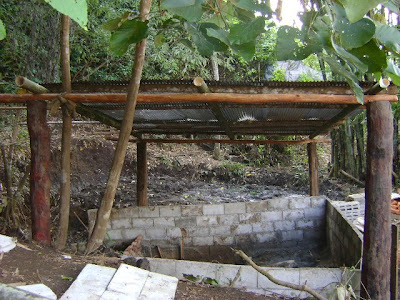
I just received a photo from a Thai friend, of the well that the Project ENP team helped to build in the village of Hui-bak-bak during our April-May expedition.
Simple happiness lies in knowing that in a short span of three days, we turned the swamp (see below) of mud, mosquito-breeding stagnant water, and overgrown trees into......

A sheltered well that is 3 m by 2 m by 1.5 m deep, and now serves as a complementary source of clean water for a village of 250 people that is 6 hours drive away from urban civilisation. This photo was taken in May shortly after we left and the well is brimming with clean water now.
The next Project ENP team is heading off in April-May next year to continue volunteer and reforestation work with the Elephant Nature Park, and work on similar projects at other villages being supported by the Park.
If you have what it takes to join the team, especially documentary and film-making skills, then please drop me a personal message!
Simple happiness lies in knowing that in a short span of three days, we turned the swamp (see below) of mud, mosquito-breeding stagnant water, and overgrown trees into......

A sheltered well that is 3 m by 2 m by 1.5 m deep, and now serves as a complementary source of clean water for a village of 250 people that is 6 hours drive away from urban civilisation. This photo was taken in May shortly after we left and the well is brimming with clean water now.

The next Project ENP team is heading off in April-May next year to continue volunteer and reforestation work with the Elephant Nature Park, and work on similar projects at other villages being supported by the Park.
If you have what it takes to join the team, especially documentary and film-making skills, then please drop me a personal message!
Making a stand as Projects Directors
Yesterday, I wrote an open letter to the Projects Directors who attended the training session on Saturday.
For them, sitting through every single critique session wasn't easy, especially when their plans were in the lines of the 'firing squad'. I appreciate their willingness to be open to criticism and learning, which forms the very basis of the Projects support network which can only grow if there is a culture of open learning.
At Saturday's session, I saw determination and tenacity in the eyes of the attendees. And my love for them and this wonderful organisation leap-frogged my lingering skepticism of my role, and the future of AIESEC Singapore.
---------------------------------------------------------------------------------------------------
Tuesday, October 13, 2009
Hi guys,
Thank you for sharing your plans with us on Saturday and contributing to the critique of your peers’ projects. Hope you all picked up new ideas and insights from each session.
Grace and I talked yesterday. We are simply amazed by all your plans and hopes for your project, and if you’re able to achieve all your targets, the net impact on AIESEC Singapore will be tremendous. AIESEC Singapore has come a long way from the past, even from last year. As an organization, we are growing. We both feel it and I hope you do feel it too.
Personally, as a projects leader in 2007\08, I never had anyone to turn to for help, no mentors to provide guidance, nor an idea of what a Pbox is (and how to design and execute one), or the luxury of having a critique session like Saturday’s. Those were the days when projects weren’t given much of a priority, when we practically didn’t have to report to anyone (because few people really cared), and had to scrimp and scrap every possible contact beyond the organization for funding and expertise.
If you think you are all alone and underappreciated now, think about how we would have felt then.
The role of a Projects Director even today is demanding. Very demanding.
Not only do you have to juggle project management and sales, you also have to manage a huge team, be responsible for member retention in your team, initiate partnerships and keep them happy, know something about marketing and PR, answer to the top (MC) and bottem (members), plus a whole lot of other factors that makes starting a new business look like child’s play. As a Projects Director, you are also forced (not asked!) to become a friend, a team worker, a mentor, a babysitter, a preacher, an activist, a partner, and many other roles.
And lo and behold, we are also full-time university students being subsidized by the wonderful taxpayers of this country!
But it is an honour and a privilege to be a Projects Director. I spent a year away from AIESEC last year. When I was away, I learnt new things that I wouldn’t have learnt in AIESEC, but I also realized that there is no other student organization that is unique like AIESEC, and a role as demanding as that of a Projects Director. Only a minority of people in our local universities have the opportunity to do what you’re doing, and grow and learn from it. But I can certainly think of many people who are hungry enough to do what you are doing but yet do not have the opportunity to do so.
Compared to other functional departments, Projects has plenty of leeway, freedom and power to try new things and experiment with new ideas. As the main engine of growth for exchanges and campus outreach for AIESEC Singapore, there is understandably plenty of expectations and demands set on you guys. And with great power and expectations, comes great responsibilities.
The Imperial British Hussars knew this well. As sword-welding horsemen who are responsible for disrupting enemy formations and stirring fear in them, they are the first to charge into battle before their infantry do. With the long lines of enemy rifles aimed at them, they knew they would be the first to die on the battlefield and the last to leave. But it was a great honour to be a Hussar, not simply for what they did and could do, but for what they stood for.
And hence, we hope that you can all stand for something that goes beyond just the mundane tasks of raising exchanges and executing forums. When you meet your team in person and try to get them excited about your plans, you stand for something. When you meet potential partners and clients, and face the prospect of being rejected, you stand for something. And when you spend the wee hours of the morning writing emails and proposals when you should be studying for a quiz, you too stand for something. That something lies in being a Projects Director for AIESEC Singapore. Think about it.
And we hope that as a community of leaders and AIESECers, we can all support each other, during our darkest hours, or during our highest peaks of triumphs. The great philosopher, Cicero, knew this when he said,” Rome became great not through its conquests, but through its undying support for its allies”. Let’s help each other by being open in sharing, learning and supporting. As a community, we will have to consciously work at growth, and grow together.
On behalf of the NTT, I would like to proudly say that it has been an honour and a privilege to be a part of the process of supporting you all through providing training, mentorship and advice.
We look forward to the next training session and till then, all the best for your projects and remember, if you need help, don’t hesitate to holler for us!
Sincerely Yours,
Kenny
Sunday, September 13, 2009
A prayer for you...
I pray again not just for your well-being and safety, but...
- For you to have a re-connection with your family, and your parents: the very people who gave life to you and spent their prime years working so that they can put you and your siblings through school for a better future
- For you to rediscover your passion and zest for life so that you will jump out of bed everyday excited to accomplish everything for the day
- For you to stay strong in your faith, knowing that if you can't see God ahead in your times of need, that's because He's always behind you to support you when you fall
- For you to have a new tomorrow that is defined not just by actions and results, but by love, relationships and the simple joy of living in the present
- For you to be true to yourself: Not by holding back because of the perpetual voice in your head that never stops telling you what to do in life, but to do what you really want to do because your heart aches for it
- For you to have the time to stop and smell the roses, lie on the grass and admire the stars, and to watch in awe the amazing sun-rise and sun-set that marks the daily passage of time for all life forms
- For you to simply be you because you are unique as created by God, not by Man or society, nor the very words that we use to put ourselves down everytime we say "I'm not good enough"
- For you to say this prayer for someone else and to pass it along. You never know how much it will mean for someone else. As much as it has helped me make someone's day, I hope it will help you make someone else' day
Amen.
Saturday, August 29, 2009
Proud of my ENP team!
We had an awesome ENP gathering tonight to debrief, gather feedback for the next Project ENP team, reminisce of the old times, and relive the fun and laughter we once had in Chiang Mai.
Tonight, I saw how powerfully bonds can be forged and last the test of time. One of our teammates, Hui Xin, took the trouble to make a team video. It was hilarious and nicely-done, definitely something that I would want to show to others to say how proud I am of the team.
Another member, Tessa, went beyond the call of duty to create mock certificates for each and every team member describing the "awards" each received during service in the team (mine read: Best leader, Best first impression but real worst impression, Best spectacle, Awesomest Ambassador of SMU, Best corn cutter, Most hardworking tubing planner, Most deluded, Most fashionably dressed in ENP, Best (and worst) matchmaker, Dr Love). Hahas!
I'm very glad that I helped to create and facilitate this eco-system of team members supporting one another even in times of adversity, commiting to the vision, and having steadfast dedication to each other. I saw pride in each person's face of what we have accomplished and who we are as a team. And I must really thank the team for sustaining this culture and moving ahead to create new possibilities for themselves.
Now, we just have to keep our word as a team. But judging how we have worked in the past, I have every confidence that we will do just that - and even beyond our expectations.
Tonight, I saw how powerfully bonds can be forged and last the test of time. One of our teammates, Hui Xin, took the trouble to make a team video. It was hilarious and nicely-done, definitely something that I would want to show to others to say how proud I am of the team.
Another member, Tessa, went beyond the call of duty to create mock certificates for each and every team member describing the "awards" each received during service in the team (mine read: Best leader, Best first impression but real worst impression, Best spectacle, Awesomest Ambassador of SMU, Best corn cutter, Most hardworking tubing planner, Most deluded, Most fashionably dressed in ENP, Best (and worst) matchmaker, Dr Love). Hahas!

I'm very glad that I helped to create and facilitate this eco-system of team members supporting one another even in times of adversity, commiting to the vision, and having steadfast dedication to each other. I saw pride in each person's face of what we have accomplished and who we are as a team. And I must really thank the team for sustaining this culture and moving ahead to create new possibilities for themselves.
Now, we just have to keep our word as a team. But judging how we have worked in the past, I have every confidence that we will do just that - and even beyond our expectations.
Friday, August 28, 2009
Will you please stop to smell the roses?

To pursue a life you have always dreamt of
And while you disappear into the twilights of a new world
How much do you remember of me
And all the good times we shared
When we stopped to smell the roses
Do they mean anything to you
For they really meant the world to me
And all it represents in my life
With my dreams and hopes for the future
You never left my mind ever since you entered
For we stopped to smell the roses
And as I think of what you might be doing now
Life's never too short to say how much I care for you
I will never know what is going on in your mind
And certainly how you are faring
But please spare for a moment in time
To once again stop and smell the roses
And when you do, I know that you are you
Saturday, August 22, 2009
A lesson in commitment
I got another breakthrough this week. Another defining moment that has quickly shaped my first week of school.
In our haste to go to visit Global Village, Kirsty and I decided on Wednesday to buy our bus tickets to KL that will leave on Friday night and return on Sunday. We were intending to skip half of the Corps Retreat over the weekend, and only attend the Sunday half of the Retreat. So happily, I bought the tickets that afternoon. Little did we know that my encounter and subsequent conversation with Shawn and Jasper would change our weekend plans drastically, and offer a lesson in commitment.
I have never seen both of them so troubled and engrossed in Ambassadorial planning work so intently before. So I offered to sit down with them and contribute to the thinking process. And surprise, surprise, did they mention about the idea of introducing (and implementing) corporate values for the Corps, including KPIs that will operationalize and measure how each Corp member display these values in their work.
You know, I so wanted to raise this idea at the upcoming Corps meeting as I strongly believed that as much as we had a solid external branding, we lacked the internal identity that was necessary to gel the Corps together, and get members to genuinely see themselves as an integral part of a well-oiled machine striving for a common vision. In short, our skills as Ambassadors provided the organisation with the "hardware", but our values and corporate belief should provide the "heartware" as well. Putting the discussion of our values as a priority for the Retreat was a God-sent surprise to me.
That is the answer to issues of morale and member commitment within the Corps. This is the smoking gun, that if properly implemented, will be the model for other student organisations to follow. This will be an experiment in organisational culture-creation, and a crucial one that was far too delayed and important to ignore.
And what touched me even more was that Shawn and Jasper offered to reinburse us out of their own pockets for our tickets to KL just so that we change our minds and stay for the Retreat. Their commitment was for all members to be present, so that everyone will be on the same page on such developments.
Well, I was speechless and really wanted to go to Global Village but I realised that as a relatively seasoned project manager and trainer on organisational culture, I could not walk away from what I preach. I have made a commitment to be part of the Corps, and I cannot walk away when my President and Vice-President have offered to go all out to make me attend the Retreat. They needed people to fight for what is right, and make a stand to introduce some bitter but much-needed medicine for the Corps to function at our 110% . We ended up debating the idea and discussing until 2 am in school. But did they win me over.
So I did the right (and some say, foolish) thing to do: I decided to skip KL, called up Kirsty to convince her to go for the Retreat, and found replacements for both of us. We decided to stay, and carry out our commitment as pledged members of the Corps.
Best thing of all? We chose to stay, not out of obligation or peer pressure, but because we chose to stay to make a difference and stay commited to a pledge we made more than a year ago, and carry out for every second we hold our appointments as members of the Corps.
Now, if only we can bring this lesson forward, make a strong case at the Retreat and Corps meeting, and deliver a powerful wake-up call to the rest of the Corps.
Monday, August 17, 2009
12 memorable things about Tokyo

It was only a short 4-day trip to Tokyo but what made the trip memorable was...
1. Admiring the beauty and fashion of its people. The girls seem to have big eyes and flawless complexions and the guys have slim bodies, sharp features, and finely sculpted hairdos (read: Takeshi Kaneshiro). Yes, even I'm awed by the guys and their good looks. Throw in the most creative, random and diverse fashion sense one can have and there you go: the va-va-vroom, in-your-face, fashionista culture of Japan!
2. Experiencing 1 minor earthquake tremor over dinner at a restaurant when the table started shaking and the light bulbs on the chandalier started grinding against each other. We woke up at 2 am the next night to the violent shaking of the hotel building when the bed vibrated on its frame and the walls seemed to want to cave in. It was over after 10 seconds but it was damn scary!
3. Walking down the narrow avenues of Harajuku (i.e. fashion street for youths) and gawking at all the teens dressed in Cosplay outfits and kimonos that make all those Japanese anime and cartoon series that I used to watch as a kid come to life before my eyes!
4. Buying 3 pieces of siew mai at the food basement of Isetan and dropping my jaw when the counter staff packed the food into a plastic packet, packed the packet in a plastic bag, and packed the plastic bag into a bigger plastic bag before sealing it. What a waste of material!
5. Having the best Yakudori (BBQ meats) meal at a restaurant in Shibuya (i.e. fashion street for the well-heeled) where the aromatic meat flavours go in sync with warm sake and home-cooked miso soup with soft Japanese rice coated with egg sauce. Yummy!
6. Tucking into the most authentic sushi meal at a 40-year-old sushi bar at the famour Tsujiki Market (the biggest fish market in the world). For a standard sushi set costing 4500 Yen (about S$65), you get an assortment of 10 different sushi types including the freshest prawn sushi I have ever tasted, and the most generous serving of unagi (sea-urchin) sushi where the unagi literally melts in your mouth. Of course, top the meal off with a bowl of home-brewed clam miso soup!
7. Laughing silently to myself when the service staff bowed to me to thank me for buying something from the store, and I bowed back to her. She responded by bowing to me again, and I bowed back. So she bowed back to me again. Haha!
8. Walking through the streets of Shinjuku, Harajuku, Shibuya, Ginza (City centre) and Akihabara (IT City) until my feet ached, and admiring the bold contours of the buildings, the creative designs of the fashion boutiques (big and small ones), the flashing neon lights of the city, and the amazing range of fashion apparel of all types and designs for sale!
9. Navigating the infamous subway system where the trains operate on as many as 12 lines which are interconnected through many interchanges. I remembered having to walk 300 m from one line to get to another line at one interchange, only to realise it is the wrong line. Then it's another 200 m to the right line. Phew!
10. Seeing the most expensive fruits on display in the supermarket. One watermelon was on sale at 4000 Yen (about S$55) and a bunch of Japanese grapes selling at 3000 Yen (about S$40). Now, that's either some pretty good-quality stuff or it's just day-light-robbing inflation going through the roof!
11. Shopping like I've never shopped before in a very long while, courtesy of generous liquidity from my Dad and sister. I like their motto: Since you pay so much to come to such places, you very well spend more because it will be a long while when you next come back again. Along the way, I became an avowed fan of Japanese apparel chain, Uniqlo, where I probably blew half of my budget shopping in!
12. Going for a holiday with my Dad, Sis and my soon-to-be Brother-in-law. Even though not all of the family could make it, it was a warm experience knowing that this is my first family trip in almost 6years, and the start of many more trips to come. Korea next year, and Australia the year after!
Monday, August 3, 2009
Because it's only human to cry...
When I think of a moment in time
It's when liking someone can be such a crime
To have to once again have your heart broken
It conjures a misery of words not to be spoken
I tell myself there really is no need to sigh
Because it's only human to cry
And when the going gets long, hard and tough
You look at life and give your biggest laugh
Sending her off today made me feel queasy
But no one said choices made have to be easy
So although at times it really leaves me hurt
It takes a man to live by his word
So fret not for I have seen the light
I realise that I'm now dug in for a fight
And like the piling up of falling summer snow
My feelings for her will only grow
Sunday, July 5, 2009
Reflections from Chiang Mai (Part 2)
When I came back from Chiang Mai slightly less than 2 months ago, I was still overwhelmed with what I've seen, done and learnt in the 2 weeks of the expedition with Project Elephant Nature Park (ENP).
As I reflected, the project represented the journey of a life-time for me, to be able to lead this project and work with an awesome team to be engaged in contributing towards elephant and nature conservation.
The following pictures are snap-shots of some of the work that the team has done since the conceptualisation of the project began last October...
 We were fortunate to be working closely Mr Grant Pereira, the Singapore Director of the Chiang Mai-based Elephant Nature Park. In January, we organised a talk on elephant conservation by Grant, as part of a series of public outreach and education initiatives.
Grant was also instrumental in being the main liaison between our team and the Elephant Nature Foundation. He was recently featured in the Channel News Asia series Saving Gaia - Asia's Leading Green Heroes.
 What is organising an OCIP without fund-raising? The team applied to be sponsored by the NYC's Youth Expeditionary Fund (YEP) which sponsored 50% of the cost of the project while SMU co-paid 10% of the cost. The balance had to be paid for by the team and fund-raised.
The 4-months-long fund-raising experience itself was extraordinary. We sold everything from popcorn, Chinese New Year goodies, postcards, ENP mementos to friendship bags filled with goodies, and our team-designed T-shirts. It was like running a 42-km marathon that required much patience and stamina.
The campaign was a success as we were able to exceed our target of $5000 and publicise this project to hundreds of our peers.
 The building block of the project is definitely the team itself. We had a team-bonding camp during the term break to build trust and friendships, and peppered our semester with facilitation sessions to learn about conservation issues, team-work, and preparations for the trip.
 On the first day of the trip at Chiang Mai, we were treated to a wonderful dinner at a cafe run by a guest inn that we stayed at for the first and last nights of the trip. Of course, on our agenda too was the shopping at the famous bazaars that sold anything from clothes to traditional handicrafts and food.
 We had to take a van on an hour-long journey to the ENP. At the first day at the Park, we were briefed on the history of the Park and safety procedures for handling elephants. We were also introduced to many of the elephants at the Park, and even had the opportunity to feed and wash them in the adjacent river.
If you thought washing your cars was just plain painful, wait till you wash these towering, humongous beasts that had to be bathed twice a day!
 Oh, how can we forget about the morning chores at the Park? Apart from cutting corn from the corn-fields in the outskirts of Chiang Mai that was meant to supplement the elephants' diet, we also collected elephant poo from the shacks that housed the elephants. The poo was meant to be transported to poo factories that made commercial items like notepads and books.
We also supported the Park in other activities such as collecting bamboo and concrete meant for the expansion of the Park's facilities.
 Planting teak-tree seedlings was fun! We spent a couple of days transporting seedlings from the nursery and planting them at selected locations along the Park. These trees will one day provide shelter and food for the elephants.
This is part of a reforestation campaign to restore the natural habitats of these elephants since the rapid deforestation and urbanisation was a contributing factor to the decline of the elephant population in Thailand.
 We spent 4 days at a Karen village that was supported by the Park. Recognising that promoting the welfare of the hill-tribes was part and parcel of preserving the eco-system involving nature and the elephant population, the Park launches many initiatives to preserve the cultural identity and welfare of these hill-tribes.
Our team sponsored the building of a well, and worked with the villages to dig the well at a site that was once a swamp consisting of a sludge pool of mud and rotting vegetation. Getting knee-deep into the mud, hacking at the ground with shovels and pick-axes, and involving the entire team to transport buckets of sludge from the well-site was simply draining but memorable.
Of course, the villagers were also exceptional hosts, always cooking and providing the best accomodation for us. They truly lived up to their reputation as a generous and welcoming people.
 That's the well that was shaping up by the second day of our digging. We had to transport sand, stones and cement from outside the village, mix them into cement, and transfer the materials into the well. By the end of the third day, the villagers had taken over the project and adding their finishing touches to the well.
 We also visited a nearby village school that served students from the nearby villages. We were thankful to have collected boxes of stationery, toys, paper and biscuits for the kids from our collection drives in Singapore, contributions from two secondary schools, and sponsors like Pilot and Blessings in a Bag.
 That's the satisfied team with the adorable kids. What better way to mark the end offour stay at the village by putting a smile on the kids' faces with our gifts and the many games we played with them? Simply priceless and worth all the effort.
So what's in store for the team and the project? We have our work cut out for us for the months ahead where we plan to:
- Work with our school's corporate communications office to create footages of the project meant for Channel News Asia to showcase the Park's work, details of our project, and our experience as a team.
- Organise a photo-essay exhibition and have it in either SMU or the National Library (or even both!). This will cap our post-expedition project of increasing publicity for what the Park does, and educating the people on the pertinent issues of elephant and nature conservation
- Have a final debriefing and official gathering for the team where we remember our work and the great times we have experienced together as a team
- Start planning with the leaders of the next ENP project! We will review our strategic branding, processes, target audiences and such. More importantly, we will see how we can ensure the continuity and sustainability elements of the project, such as the idea of the social business that the school intends to start to market products made by the constituents of organisations like ENP
Tuesday, June 30, 2009
Reflections from Chiang Mai (Part 1)
I realised I have not had the chance to blog about one of the main projects I've been working on: Project Elephant Nature Park. Leading this team of 20 people on a project that was conceptualised since last October, and not expected to end until this November, is not easy.
It was a journey fraught with many professional and personal challenges for many of us, but it opened our eyes to what can be achieved so long we set our heart and soul to what we want to achieve as a team.
 You guys rock man! I promise that we will finish the last leg together as a team. And we will finish well.
 Thank you so much for your support! Watch out for our planned photo-essay exhibition at the end of this year. And stay tuned for more details...
It was a journey fraught with many professional and personal challenges for many of us, but it opened our eyes to what can be achieved so long we set our heart and soul to what we want to achieve as a team.
But one picture clearly summarises my feelings for this project and the team:
You guys rock man! I promise that we will finish the last leg together as a team. And we will finish well.And to our wonderful, wonderful supporters who have contributed in cash, in-kind, or just your prayers and encouragement, here's something for you:
Thank you so much for your support! Watch out for our planned photo-essay exhibition at the end of this year. And stay tuned for more details...
Subscribe to:
Posts (Atom)
